What AI Reveals About Product Management
AI automates product artifacts but highlights what still matters: judgment, synthesis, and deep context. Learn where human product leadership adds value.
If ChatGPT writes better user stories than you in half the time, the next executive question sounds almost logical: "Do we still need Product Owners if AI handles their tasks?" That framing is wrong. AI automates the artifacts of product work but does not replicate the thinking behind them. What remains — contextual understanding and sound judgment — is the harder and more consequential part.
Whether you operate as a Product Owner (PO) within a Scrum team or as a Product Manager (PM) with a broader strategic remit, the core challenge remains the same — navigating complexity and making informed decisions that balance user value and business impact.
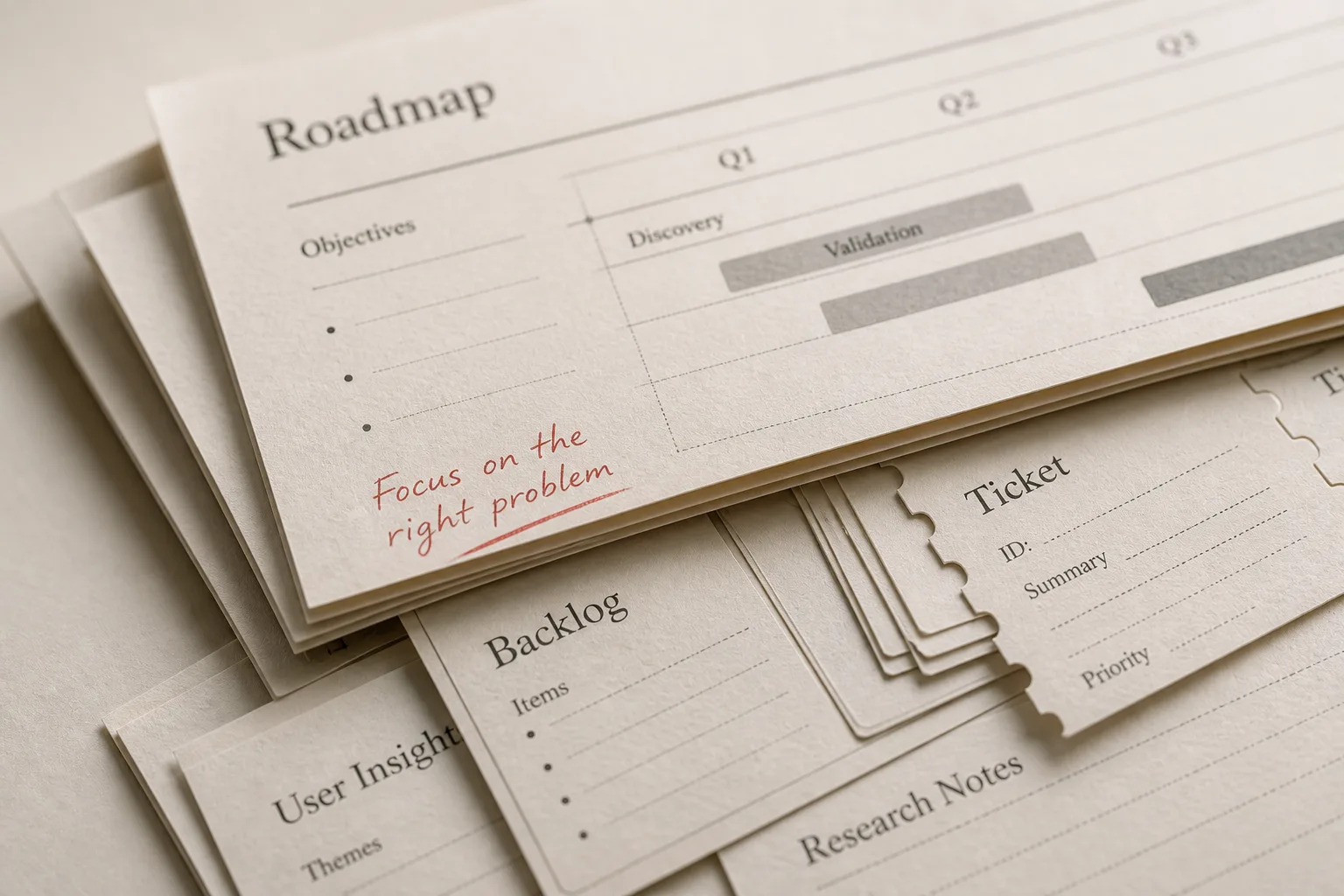
The Three Layers of Product Responsibility
1. Artifacts (Largely automatable)
- User stories
- PRDs (Product Requirements Documents)
- Roadmaps
- Competitive analyses
- Status reports
2. Synthesis (AI supports and enhances here)
- Summarizing research and insights
- Interpreting complex datasets
- Assessing technical feasibility
- Spotting relevant market signals
3. Judgment (Remains a human responsibility)
- Making strategic decisions under uncertainty
- Aligning multiple stakeholders amidst ambiguity
- Reading between the lines of user feedback
- Building and maintaining cross-functional team trust
Many junior POs spend a large share of their time on the first layer. AI can shift that focus toward synthesis and judgment. One way to start: run the 30-minute audit below and reverse-engineer an AI-generated PRD to find what it missed.
Immediate Steps You Can Take Today
30-Minute AI Audit
Paste this prompt into ChatGPT:
Analyze my typical PO workweek: [your last week’s calendar & task list]. Classify each activity into artifacts (largely automatable), synthesis (AI-assisted), or judgment (human responsibility). Show me where to focus my growth.Reverse-Engineer AI Outputs
Take an AI-generated PRD and pinpoint what’s missing: user-specific context, technical constraints, long-term business goals. Those gaps are exactly where you add value.
Use AI as a sparring partner
Reflect using this prompt:
Challenge my last significant product decision: [describe your decision]. What assumptions could be wrong? Which alternatives are viable? What additional data might change my mind?Product Owners aren’t disappearing — they’re just running out of excuses to stay in the artifact layer.