GEO: What AI Overviews Really Change About SEO
GEO remains SEO, but adds a measurement layer: whether content is found, cited and represented accurately in AI Overviews and ChatGPT.
A good Google ranking can still generate clicks. But it does not guarantee that a page will appear as a source in a generative answer. Conversely, a source may be cited without receiving meaningful referral traffic.
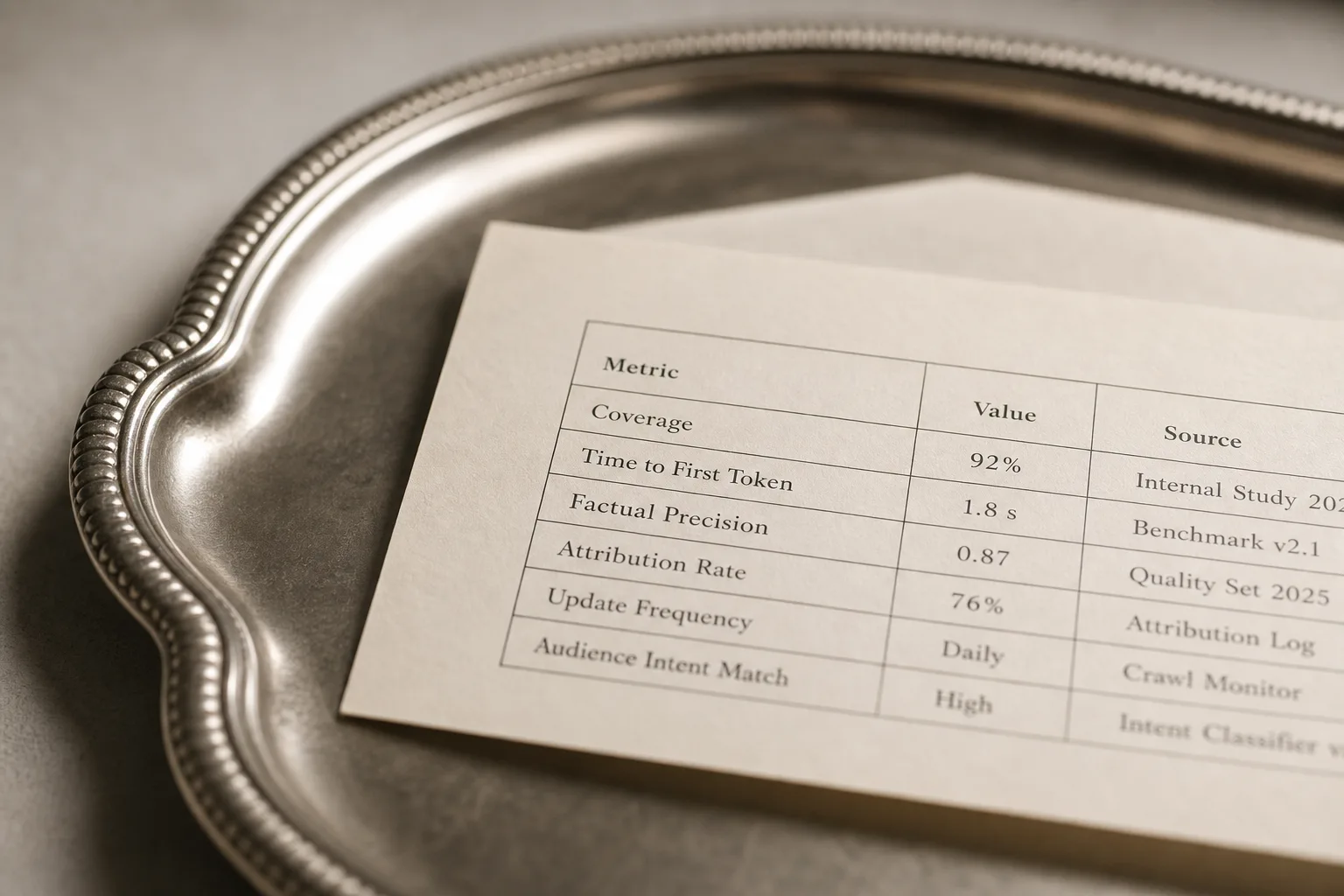
Generative Engine Optimization, or GEO, describes the content and measurement work around generative search answers. For Google, it is not a replacement for SEO. Google still identifies helpful content, crawlability, visible text and a clean page structure as the foundation. There is no special AI markup, mandatory llms.txt file or separate writing style required for AI Overviews.1
What is new is the additional measurement layer. Teams need to keep four questions separate:
- Is the page found?
- Is it selected as a source, or is the brand mentioned?
- Does the answer represent the claim accurately?
- Does this lead to a click, an enquiry or another business outcome?
Compressing these layers into a single “AI visibility” score makes it easy to measure the wrong thing.
The website remains a destination, a source and an interface
Answer engines do not make websites obsolete. They change how people and systems access content. A page can still be a destination for readers while also supplying material for a summary. Browser agents may additionally use it as an interactive interface.
That expands the website's job. Important information needs to appear in visible content, be discoverable internally and remain technically accessible. Interactive journeys also require clear labels, robust forms, authentication and secure confirmation steps. This does not automatically turn a website into an API. It gives the site another machine-access layer.
OpenAI describes the technical requirement for ChatGPT Search in similarly plain terms: publishers that block OAI-SearchBot cannot be considered as web sources there. Allowing it guarantees neither a citation nor a position. Attributable referrals can be observed in analytics through utm_source=chatgpt.com.2
Three layers instead of GEO tricks
1. Remain technically accessible
Crawlable URLs, visible text, coherent internal links and consistent canonicals remain the foundation. Semantic HTML helps readers, assistive technologies and maintainability. Google does not, however, need a perfect DOM or special AI-specific HTML to understand a page.1
Structured data can give search engines additional signals about entities and content types. It must match the visible content. That does not make it a direct lever for AI citations.3
2. Provide supportable, original substance
Generic summaries are easily interchangeable. Original data, reproducible tests, concrete cases, clear authorship and sources placed next to the relevant claims are more useful. None guarantees a citation. They make content verifiable and distinctive.
One example makes the difference concrete. A generic post titled "Five Tips for Lower Interest Rates" offers little that counts as real experience. A post built around an actual client case, a mortgage advisor walking through the real steps, obstacles and outcome, makes that experience visible, especially once it names its author and sources. Google flags exactly this kind of thing as a signal of first-hand experience and expertise. It still does not guarantee a citation.1
The GEO benchmark by Aggarwal and colleagues offers a limited research finding here. In a simulated setup using Google's top five sources and GPT-3.5, adding sources, quotations and statistics improved the paper's own visibility metric. For “Cite Sources,” the source ranked fifth gained 115.1 percent in Table 2.4 The experiment tested neither Google AI Overviews nor CTR, traffic or schema markup. It therefore does not show that a page at position 47 can outrank a page at position 3 as an AI source by adding schema.
Format should follow the task. A comparison belongs in a table, a process in a list, and a reasoned assessment may require longer prose. Google specifies neither an ideal word count nor artificial chunking.1
3. Keep claims consistent across multiple sources
Answer engines do not rely only on the main landing page. They may draw on website content, videos, forums and other publicly accessible sources. That makes credible external mentions and consistent company information relevant. It does not justify artificial mention networks or a fixed hierarchy of platforms.
One scenario makes this plausible, though it remains unproven: a small, technically clean website shows up less often in answers than a bigger competitor whose leadership regularly appears on industry podcasts, panels and in trade press. As a hypothesis, that tracks. As a rule, it does not hold. This is not about a fixed hierarchy of platforms, but about additional, credible external traces.
What matters is the quality of the trail. Are the name, offer, price, validity period and authorship consistent across the site's own pages? Are outdated PDFs still discoverable? Does a case study actually support the promise in its summary? For regulated content, that question leads directly to content governance and interpretation stability.
Two mistakes that don't help
Stuffing a keyword into the text more often than it needs to be there mostly hurts readability and precision. In the Aggarwal benchmark, keyword stuffing produced little to no measurable benefit for the paper's own visibility metric.4 Google's guidelines argue against this kind of manipulation anyway.1
Contradictions in your own metadata don't help either. Say the code lists January 10 as the publish date, the page shows visitors January 15, and the metadata says January 12. That makes it harder for people and systems alike to judge how current and reliable the page is. It's a small detail, and an easy one to miss.
Longer questions, clearer intent
Short keywords remain relevant, but they are now joined by longer, conversational questions. Instead of typing just "luxury watch investment," people are more likely to ask something like: "What's the best luxury watch to invest in as a beginner, under 10,000 euros?"
These longer questions carry less search volume. But they can signal clearer intent, even though there is no solid conversion figure to back that up. A look at your own Search Console shows whether and how much that matters for your site, better than any general rate would.
What research observes—and what it does not
Source selection in AI Overviews does not simply copy the first results page. A preprint by Xu, Iqbal and Montgomery examined 55,393 trending queries over 40 days. Almost 30 percent of cited domains did not appear on the simultaneously visible first results page. At the same time, 11.0 percent of the atomic claims examined were not supported by the cited pages.5 These are figures from that sample, not a general Google error rate.
Click losses are measurable, too, but they are not universal. In a difference-in-differences design covering 161,382 matched Wikipedia article-language pairs, Khosravi and Yoganarasimhan estimate about 15 percent less daily traffic to English-language articles exposed to AI Overviews.6 The finding applies to this Wikipedia setup. The different click studies and their limitations are covered in more detail in Why Google Clicks Are Disappearing.
A healthcare-search example
A commercial analysis by SE Ranking shows why vendor figures need careful reading. In December 2025, it examined a one-time sample of 50,807 German-language health prompts in Berlin and evaluated 465,823 source references.7
At URL level, 36 percent of references ranked in the organic top 10, 54 percent in the top 20 and 74 percent in the top 100. According to the vendor's classification, scientific publications accounted for 0.48 percent; YouTube received 20,621 references, or 4.4 percent. SE Ranking assigned 65.55 percent of references to its broad “less reliable” category.
The count shows a heterogeneous source landscape. It does not show that Google weighs “domain authority against expertise,” or why individual domains are cited. Particularly in healthcare, source quality and accurate representation must be assessed separately.
A small measurement routine that supports comparison
A reliable baseline does not require a new platform. A fixed spreadsheet is enough to start:
| Layer | Minimum measurement |
|---|---|
| Web search | GSC impressions, clicks, CTR and landing page |
| Generative Google search | separate Gen AI report, if enabled for the property |
| Answer engines | fixed prompt set with model, date, language, region and multiple runs |
| Source quality | cited URL and source type |
| Claim quality | accurate, partial, overbroad, outdated or unsupported |
| Business outcome | attributable referrals, branded searches, leads and conversions kept separate |
Since June 2026, Google has been rolling out a dedicated Gen AI performance report for a subset of sites.8 Its data should not be mixed with manual ChatGPT or Perplexity samples. Models, source access and answers change; a prompt measurement is always a dated snapshot.
Four levers for your visibility trail
The consistency described in the previous section breaks down into four practical levers. None of them guarantee a citation. What they do is lower the risk of showing up with outdated or contradictory information:
- Presence: your brand should show up in wikis, databases and reputable trade sites. Those are the sources answer engines draw on more often.
- Positioning: say "budget" today and "premium" tomorrow, and you make it harder for both systems and people to place you. A clear, consistent message helps either way.
- Perception: what people write about you on Reddit or review sites can carry more weight than your own website, if a system pulls from sources like those.
- Persistence: content that's stable and maintained over the long term is easier to find reliably than a short-lived campaign page.
Regularly checking how answer engines describe your brand, and fixing outdated or contradictory information quickly, keeps this trail clean. It's not a guarantee of citation.
What remains
GEO is most useful when it does not become a collection of tricks. The technical foundation remains SEO. What gets added is supportable original substance, verifiable representation across multiple sources, and measurements that do not confuse visibility, citation, accuracy and impact.
That is less spectacular than promising that schema can make a page at position 47 the preferred AI source. It is also testable.