Verbalized Sampling: More Creative AI Responses Without Fine-Tuning
A prompt for more varied responses, with rough model probabilities, a cost trade-off, and a clear selection rule.
There's a strange paradox in modern language models: they're impressively smart, yet they often sound like they've settled on one single, "sensible" voice. Friendly. Balanced. Low-risk. And, over time, predictable.
Research has a name for this: mode collapse. It doesn't mean a model suddenly becomes useless. After alignment, say through RLHF, a model can homogenize more strongly toward the same response mode, especially on tasks with several good answers: creative writing, dialogue, open-ended questions, brainstorming. Verbalized Sampling starts exactly there: instead of immediately choosing one answer, the model is asked to produce several candidates together with a rough, self-estimated distribution.
The method comes from the arXiv preprint Verbalized Sampling: How to Mitigate Mode Collapse and Unlock LLM Diversity. The current version, v4, was published on July 15, 2026.1 In the paper’s creativity test, the method increased measured diversity by a factor of 1.6 to 2.1 compared with direct prompting. That is a finding for the tasks and models tested there, not a general multiplier for every AI output.
The problem the method addresses
The paper investigates a form of response homogenization: after post-training, models may converge more often on similar response patterns in tasks with several good solutions. The authors examine Typicality Bias as a possible explanation. Typical and familiar responses may be favored during selection.
This is a hypothesis supported by experimental indications, not proof that alignment smooths every model or culture in the same way. A later preprint also finds strong homogenization, but substantial differences between tasks and model families.2
How Verbalized Sampling works
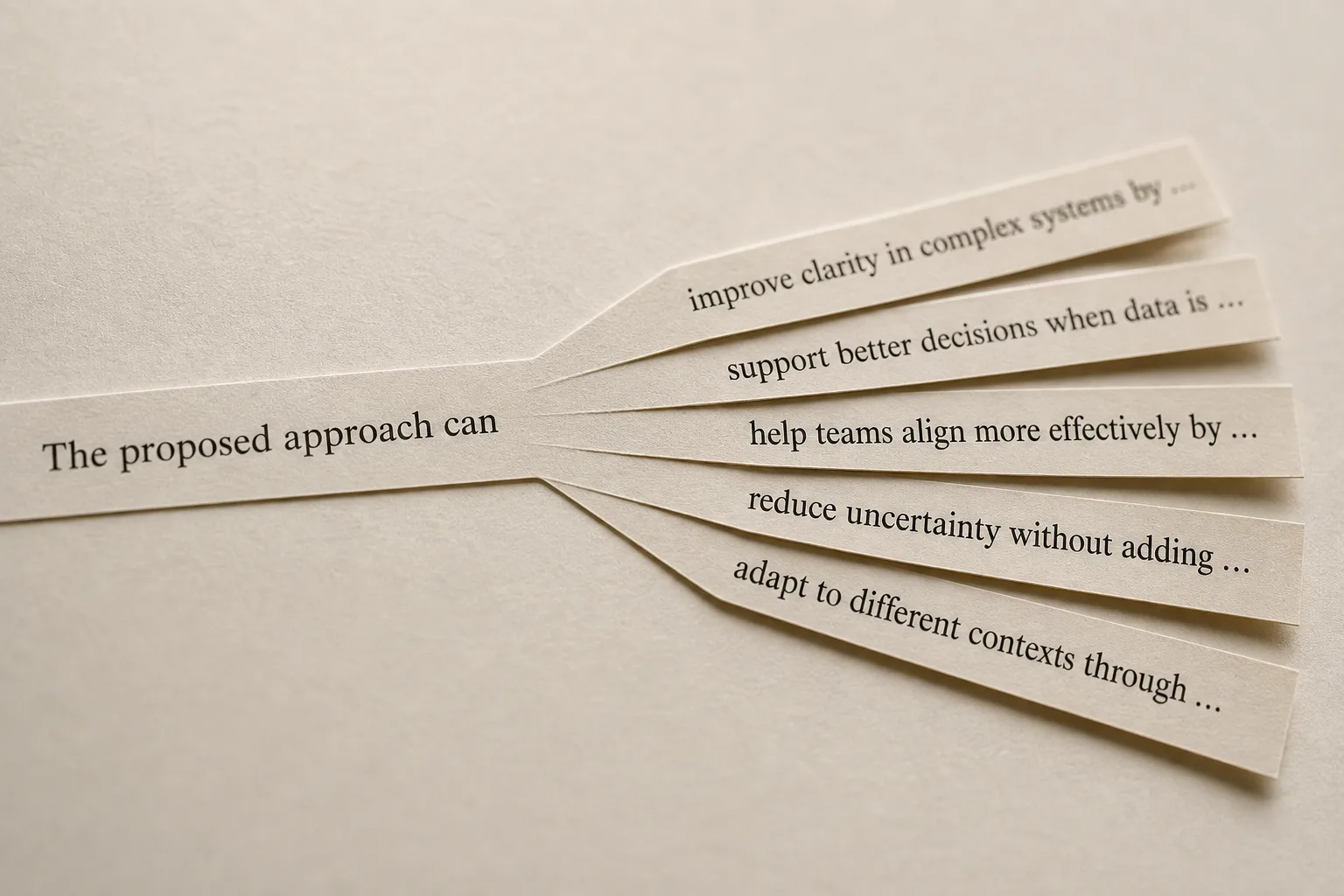
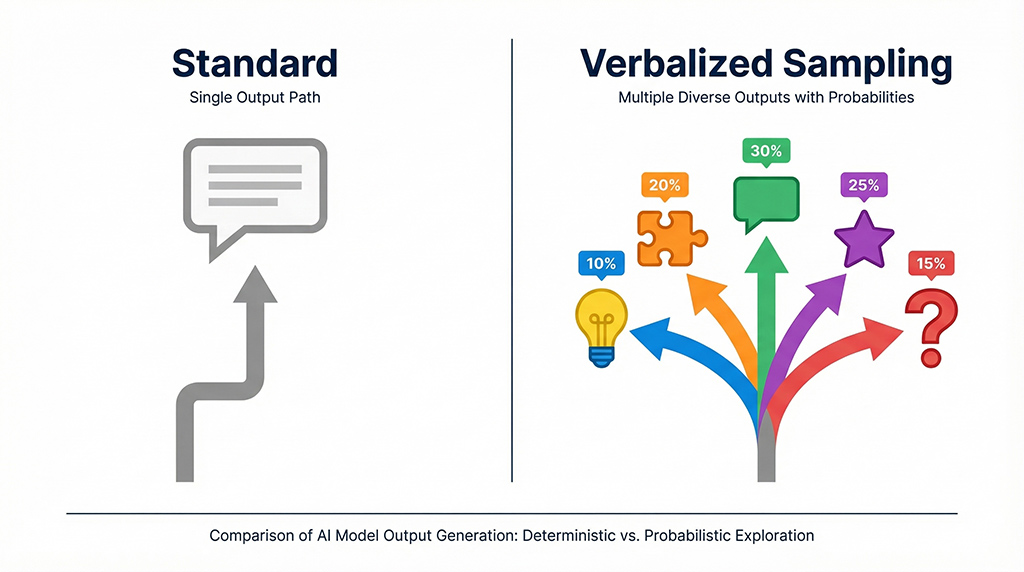
With direct prompting, the task is essentially: “Give me the best answer.” Verbalized Sampling changes it to: “Show me several plausible answers and estimate their relative probability.” This also brings variants into the output that the model would not have ranked first.
From a workflow perspective, VS feels like a lever against the built-in "be careful" reflex many models have. You force the system to show more of what it already knows but normally wouldn't offer as its first choice.
A useful base prompt looks like this:
Generate 5 different, plausible answers to the question.
Give each one a rough, relative probability; the total should equal 1.0.
Include at least two unusual but plausible variants.
The numbers are a verbalized heuristic, not actual token log probabilities.
Then mark which answer best suits my objective and explain why.

Question: What unusual opening would work for an essay about digital fatigue?
The probabilities are self-reports from the model. According to the paper, they are not perfectly calibrated and work with varying success depending on the subject. They help organize the candidates but must not be treated as measured token probabilities.
Candidates are not yet sampling
In a chat, the prompt initially produces a set of candidates. A complete sampling workflow combines three steps:
- generate several candidates,
- output a verbalized distribution,
- then select randomly or according to a rule defined in advance.
If I simply mark the most suitable candidate, I am using VS as a multiple-perspective prompt. To draw a candidate according to the distribution, I need a random selection rule or the official package. This distinction prevents a polished list from being presented as reproducible sampling.
For factual questions, the selection should not depend on an uncalibrated number alone either. Sources, uncertainty, and expert review remain more important than the probability assigned by the model.
What v4 reports about quality and effort
In the paper, human ratings of quality for the tested creative tasks remained roughly comparable, but were not consistently better. Safety scores in the StrongReject set examined also changed only slightly. Neither result guarantees the same outcome for other models, tasks, or safety tests.
The paper also reports a trend: more capable models benefited more from VS in the tests. That matches the intuition: the larger a model's internal space of possibilities, the more it pays off to actually draw it out.
The earlier claim of two to five times the token overhead was too high. In the paper’s own cost table, standard VS cost about 1.12 times as much and took 1.23 times as long as the direct baseline. Variants with additional reasoning or multiple runs were more expensive. These figures come from the paper’s measurement setup and are not a fixed API cost calculation.
Where the method reaches its limits
VS is not a magic wand: it's an inference-time tradeoff.
- More candidates require additional tokens and review time.
- Verbalized probabilities may be poorly calibrated: the numbers are sometimes closer to “calibrated storytelling” than real model probability.
- More diversity can also produce unsuitable or excessively scattered responses.
- Schema or format compliance does not replace substantive review.
- Safety must be tested for the model and the specific use case.
A later study on population simulation shows the trade-off particularly clearly: VS increased dispersion there but could shift from underdispersion to overdispersion.3 More diversity is therefore not an end in itself. It has to suit the task.
When I would use VS
The method is well suited to ideation, open-ended explanations, dialog variants, and tasks where the first plausible response is not automatically the most interesting one. For a straightforward fact lookup, a small format change, or a tightly controlled production step, the additional candidate space is often unnecessary.
Classic sampling parameters such as temperature or top-p also remain options. They act at a different control point: the provider changes the technical token selection, while VS makes the candidate space visible through the prompt. The paper combines both approaches as well; they are not generally interchangeable recipes.
VS is especially strong when you can feel it: “The model can do more. It just isn't showing it.”
For structured, machine-readable results, the article on taxonomy, JSON Schema, and Structured Outputs is the more suitable next read. My weekly AI briefing agent shows what prompt iteration looks like in a running system.
Sources & References
Material on the method: the project website and the code and reproduction materials from CHATS Lab. Both are the authors' own companion material, not independent evidence.