When LLMs Become the Browser: What Changes for the Web
If navigation shifts from links to answers, reach, discoverability, and brand presence all change. What that means for the web and for visibility.
We still browse websites, click links, Google our way from question to question. But what happens when even that interaction becomes obsolete—replaced by large language models that just deliver what we want to know?
Instead of hopping between tabs, we could soon be navigating through dialogue. In that world, the model becomes the interface—and the internet reshapes itself around it.
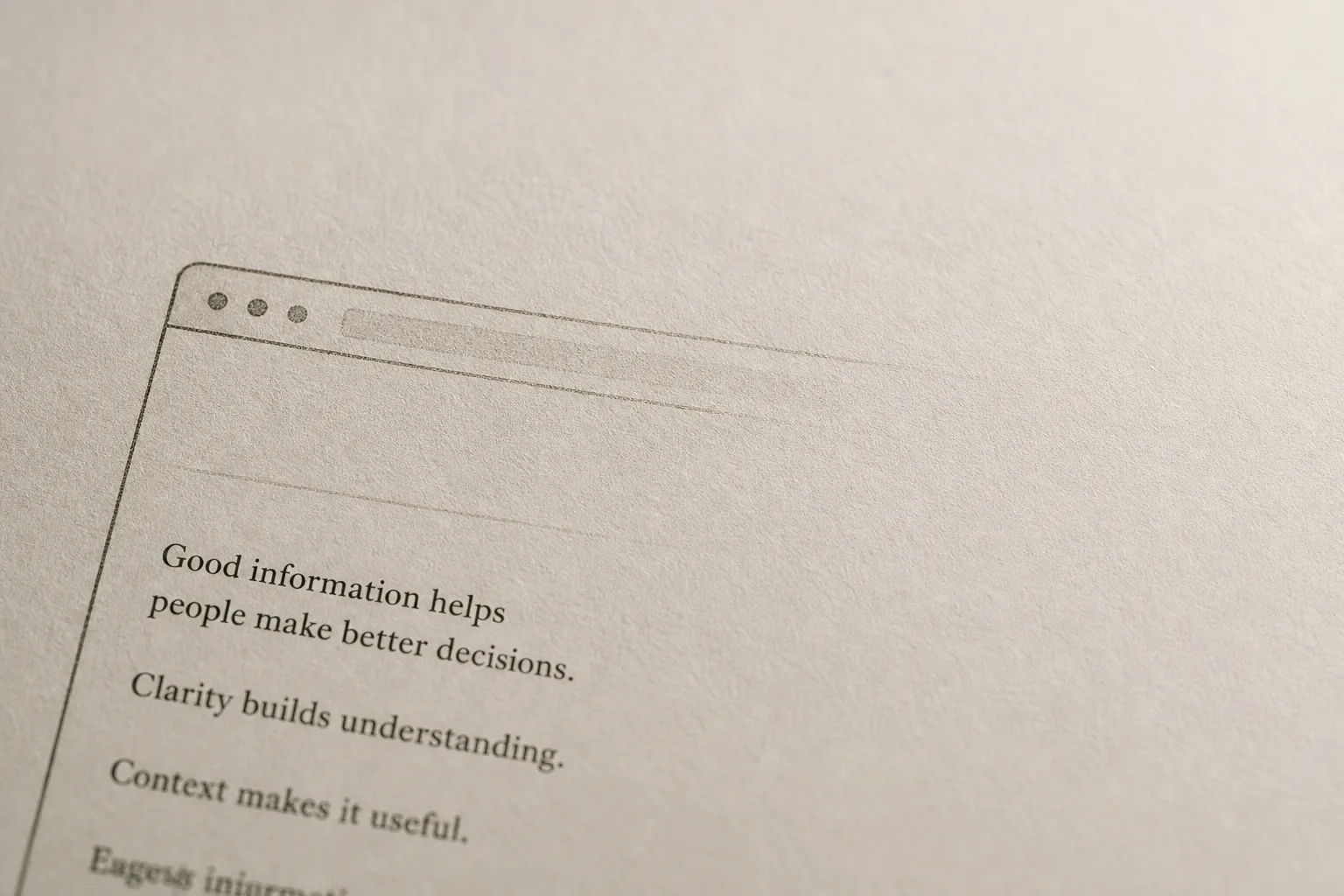
The internet becomes a database
The web as we know it — colorful, chaotic, packed with banners — moves into the background. It becomes a supplier. Websites start to behave more like APIs.
What might change?
- Websites lose their sense of place: You no longer visit a page. You consume its content while the model handles design, navigation and presentation for the task at hand.
- Affiliate links lose their foundation: Instead of clicking “The 10 best toasters,” you ask for one recommendation that fits your kitchen. The referral economy has to adapt.
- Influencers become agents: Instead of watching stories, you talk to a licensed digital version of a creator that responds in their style.
- SEO filler loses value: Content written only to rank has less to offer an answer engine. Clear claims and verifiable sources become more useful.
- Filter bubbles become selectable: Instead of installing an ad blocker, you choose a perspective — for example, news explained through an economic or Stoic lens.
- Onboarding shrinks to one sentence: You state what you want to achieve and let the model handle the intermediate steps.
Opportunity and risk arrive together
The upside is obvious: less noise. Fewer cookie banners and pop-ups, more direct access to information.
The harder question is who controls the answer. Google still gives you a list of results and lets you choose which source to trust. If a model serves one synthesized answer, that power becomes more centralized. Companies may then compete less for banner space and more for favorable representation in the model's output.
We cannot yet know how large that contest over interpretation will become. Falling Google click rates are an early signal, as described here.
For creators and companies, this means your content’s visibility may depend less on SEO and more on structured, model-readable formatting (see Controlling AI Understanding).
Perhaps “surfing” really will fade. The remaining question is who builds the filter through which we see the world.
If you're wondering how to build your own filter for this new world, I wrote about that separately: You don't need to keep up with everything.