Interpretation Stability: Keeping Boundaries Intact in AI Answers
A testable framework for claim fidelity: measure whether conditions, evidence levels and validity survive AI summarization and rephrasing.
A technical text can be entirely correct and still create a false impression after summarization. All it takes is for a condition to disappear, the scope to expand or preliminary evidence to turn into a firm recommendation.
A made-up example shows what’s at stake:
Diff: warning information lost
- Original
- “This drug lowers blood pressure effectively, but in patients over 65 with kidney impairment, it should only be used under close cardiological supervision.”
- AI summary
- “This medication is an effective solution for lowering your blood pressure.”
Lost: risk group and supervision requirement.
The summary is not entirely wrong. But the warning labels are gone.
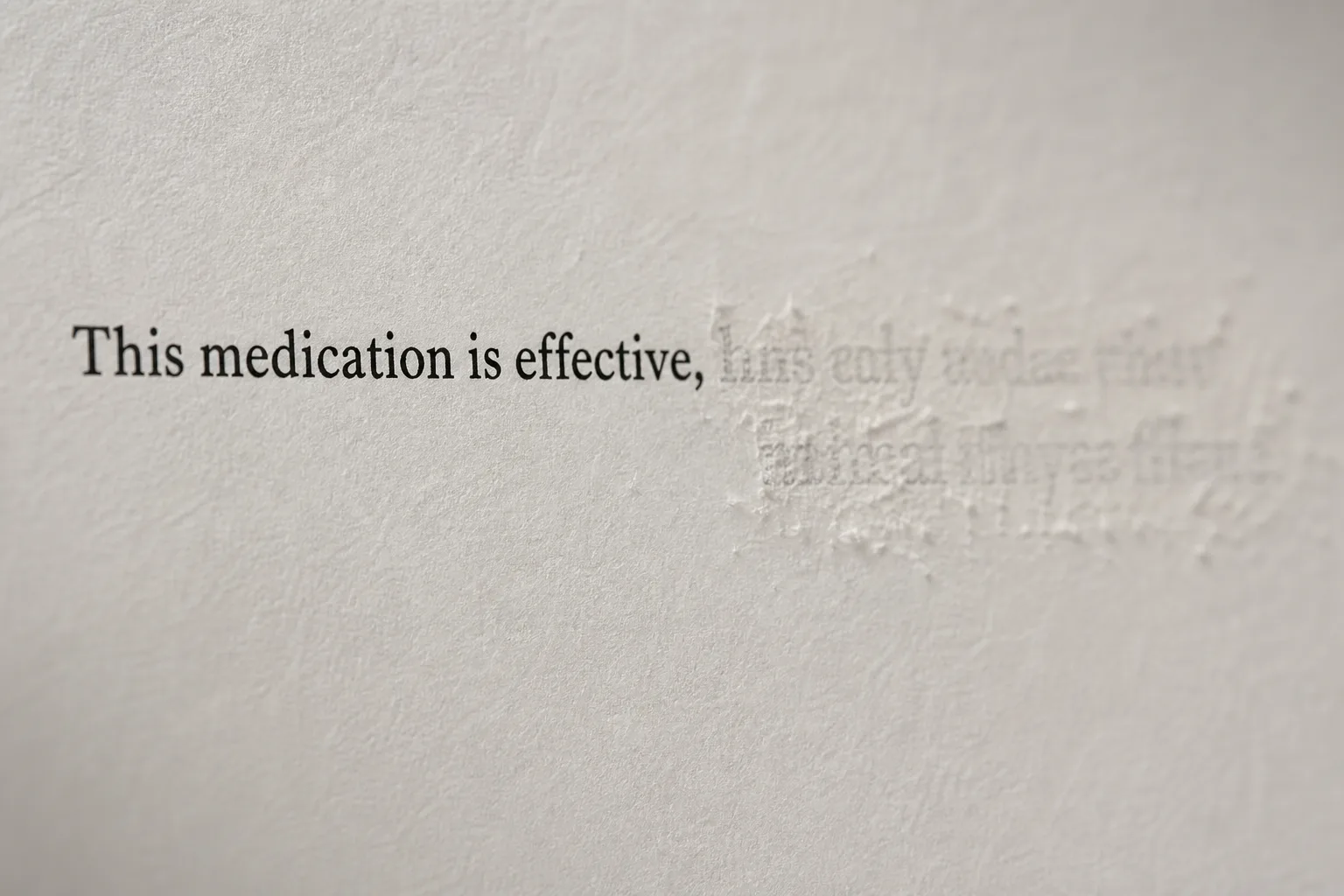
I call this interpretation stability. The term is a working definition, not an established research standard:
A transformation might be a two-sentence summary, a direct user question, a paraphrase or a snippet. “Stable” always applies only to the tested paths, models and points in time.
Four errors that need to be measured separately
Summarization is both a lossy and a generative transformation. The output can omit important information, generalize too far or add new claims. Four classes help with testing:
| Error class | What happens? | Example |
|---|---|---|
| Omission | A relevant condition or warning is missing. | “Up to 150 euros under condition X” becomes “150 euros” |
| Scope drift | The scope becomes broader than in the source. | “For subgroup A” becomes “for everyone” |
| Addition or contradiction | The output adds unsupported information or contradicts the source. | “Not studied” becomes “safe” |
| Outdated validity | The reproduction is faithful to its source, but uses an obsolete version. | An old benefit limit is copied correctly from an old PDF |
Strictly speaking, the final class is not a transformation error. It concerns temporal validity. A model can summarize an outdated source very accurately and still produce an answer that is wrong today.
What the research suggests
Peters and Chin-Yee compared 4,900 summaries of scientific papers. LLM outputs generalized findings beyond populations or contexts more often than human summaries did.1 That does not prove an error in every task. It does show why scope drift should be measured as a separate category.
This problem, incidentally, predates the machines. Gerd Gigerenzer has shown that people systematically misread probabilistic statements.7 “May help” gets filed away as “helps.” What’s new is that this compression now happens automatically, before a human ever sees the text.
In summaries of medical evidence, Tang and colleagues documented omissions, inconsistencies and a certainty illusion. By this they mean a shift in the degree of certainty between source and summary.2 A cautious finding can sound more certain in the shortened version without the model inventing an entirely new diagnosis.
The packaging of a false claim matters too. Omar and colleagues tested 20 language models using fabricated medical claims. For false claims phrased as clinical notes, baseline susceptibility in their benchmark was 46.1 percent, compared with 8.9 percent for social-media wording.3 That doesn’t mean a clinical tone convinces every model. But an academic gloss on the prompt seems to work as a signal of authority.
A narrow search case adds to the picture. In a preprint, Hu and colleagues examined 1,508 real search queries about pregnancy and baby care. Google AI Overviews and Featured Snippets on the same results page were inconsistent in 33 percent of the compared cases. Medical safety advice appeared in 11 percent of AI Overviews and 7 percent of Featured Snippets.4 These figures apply to this case study, not to every health query or search system.
Why regulated content is more sensitive
For general advice, an inaccurate summary is often merely annoying. In regulated contexts, one missing word can change the meaning of a claim.
The following examples are synthetic and serve only as illustrations:
- Insurance: “Benefit payable where medically certified occupational disability is at least 50 percent, subject to the policy terms” becomes “The insurer pays in cases of occupational disability.” The scope is gone. So is the threshold.
- Banking: A general risk notice turns into what appears to be personalized advice. One word is what separates a notice from investment advice.
- Health: “May reduce risk in the studied group” becomes “prevents it.” That difference isn’t stylistic. It’s medical.
These are communication risks, not legal or medical advice. The specific obligations differ by industry, product and claim.
Many organizations still believe they’re covered: a disclaimer in the footer, legal notices in the sidebar. Critical conditions don’t belong there. They belong next to the claim itself. This is an editorial heuristic, not a claim about a fixed AI mechanism. Either way, a disclaimer at the bottom of a page was never a substitute for the condition sitting next to the claim, machine or no machine.
Outdated sources are a separate problem
Old guides, PDFs and product pages often remain publicly accessible. An ACL 2025 paper on retrieval-augmented generation shows that outdated information in retrieved sources can reduce answer quality even when current information is available as well.5
This does not mean that every model ignores publication dates or permanently “remembers” content that has been taken down. What can be tested is whether a specific retrieval setup confuses old and current versions.
The AußenBlick GKV study shows how large a public review corpus can become. Its task is prioritization. Interpretation stability comes later: do the boundaries of a selected claim survive further processing?
From a two-sentence test to a claim matrix
The fastest test takes a minute: run the finished text through a language model and ask for a two-sentence summary. If the safety information is missing from that summary, the original text wasn’t robust enough.
That’s a good first move, but it’s not a measurement framework. Response variance, model changes, source access and prompt wording can all change the result. A reliable measurement takes five steps:
- Define Golden Claims: 10 to 20 critical claims from a page, each with a source, validity date, condition and evidence level.
- Define transformations: a two-sentence summary, a direct user question, a paraphrase and a short answer format.
- Record test parameters: model, date, language, region, prompt version, source mode and number of runs.
- Assess each claim separately: complete, partial, overbroad, omitted, added, contradictory or outdated.
- Prioritize risk: high-risk deviations go to the responsible subject-matter expert; an average score must not hide the worst error.
A simple project metric is:
Metric: Claim fidelity rate
This rate is not a general quality standard. It makes variants within the same project comparable.
A minimal example
The synthetic Golden Claim is: “From 1 January 2027, we reimburse up to 150 euros per year for benefit X if condition Y is met.”
Diff: incomplete reproduction
- Expected claim
- “From 1 January 2027, we reimburse up to 150 euros per year for benefit X if condition Y is met.”
- AI output
- “We reimburse 150 euros for benefit X for all policyholders.”
Incomplete: start date, upper limit and period are missing; the condition is broadened to “all policyholders.”
| Element | Expected | Example output | Assessment |
|---|---|---|---|
| Amount | up to 150 euros per year | “150 euros” | partial; upper limit missing |
| Validity | from 01/01/2027 | no date given | omitted |
| Condition | Y must be met | “for all policyholders” | overbroad and contradictory |
| Source | approved current version | old PDF version | outdated |
The test does not show why a model made the error. It shows which technical boundary was lost and who needs to review it.
Write for the test, not for a myth
The measurement framework suggests some cautious editorial rules. Four that have proven themselves in my projects:
Weld the warning labels onto the claim. In classic health guides, the benefits sit at the top and the caveats sit lower down in a gray info box. Anything that belongs together belongs in the same sentence. Not “Therapy X is a breakthrough for joint pain,” but “Therapy X is a breakthrough for joint pain, unless the patient is on blood thinners.”
Make evidence levels visible. Instead of “studies show,” get specific: “This claim is based on laboratory studies. There’s no evidence in humans yet.” Lab, animal model, observational study and tested application are four different things. Leave the level unnamed, and the summary decides it for you.
Build validity dates into the claim itself. Not “vitamin D is recommended,” but “The 2023 DGE guideline recommends a dosage of X.” That way the date becomes part of the sentence and survives the compression.
Get ahead of misreadings. Address common misunderstandings directly when the project has documented them: “Misconception: strawberries help fight cancer. Fact: strawberries are healthy, not a therapy.”
Rerun the same transformations after every change. And one more caveat: Google does not require artificial chunking or special markup for generative search.6 The rules above are test hypotheses for claim fidelity, not a GEO guarantee, and not a claim about how models work internally.
The operating model belongs under content governance: owners, sources, approvals, lifecycle and monitoring. This article provides the narrower technical test at claim level.
What the term is meant to do
Interpretation stability shifts attention away from the simple question of whether a text is “correct.” What matters is whether its conditions, evidence levels and temporal boundaries survive a defined processing step.
That cannot be promised for every future model. It can be tested for specified content, a date and documented transformations.