Hanzi Movie Method: AI as a Screenwriter for Your Memory
Actor, Set, Room, Props, Script: how the Hanzi Movie Method turns Chinese characters into movie scenes. A free browser app writes the scripts — no sign-up.
Learning Chinese characters is hard work. Around 3,000 common characters cover a very large share of Chinese texts. That is a rough guide, not a universal minimum for reading. Every character has a meaning, a pronunciation, and a tone, and your brain has to retrieve all three at once.
Most people try flashcards and repetition. It works, but it takes forever and feels like learning vocabulary at school. There is a better way and an app that puts it into practice: Hanzi Movie Studio (right in your browser, with no sign-up).
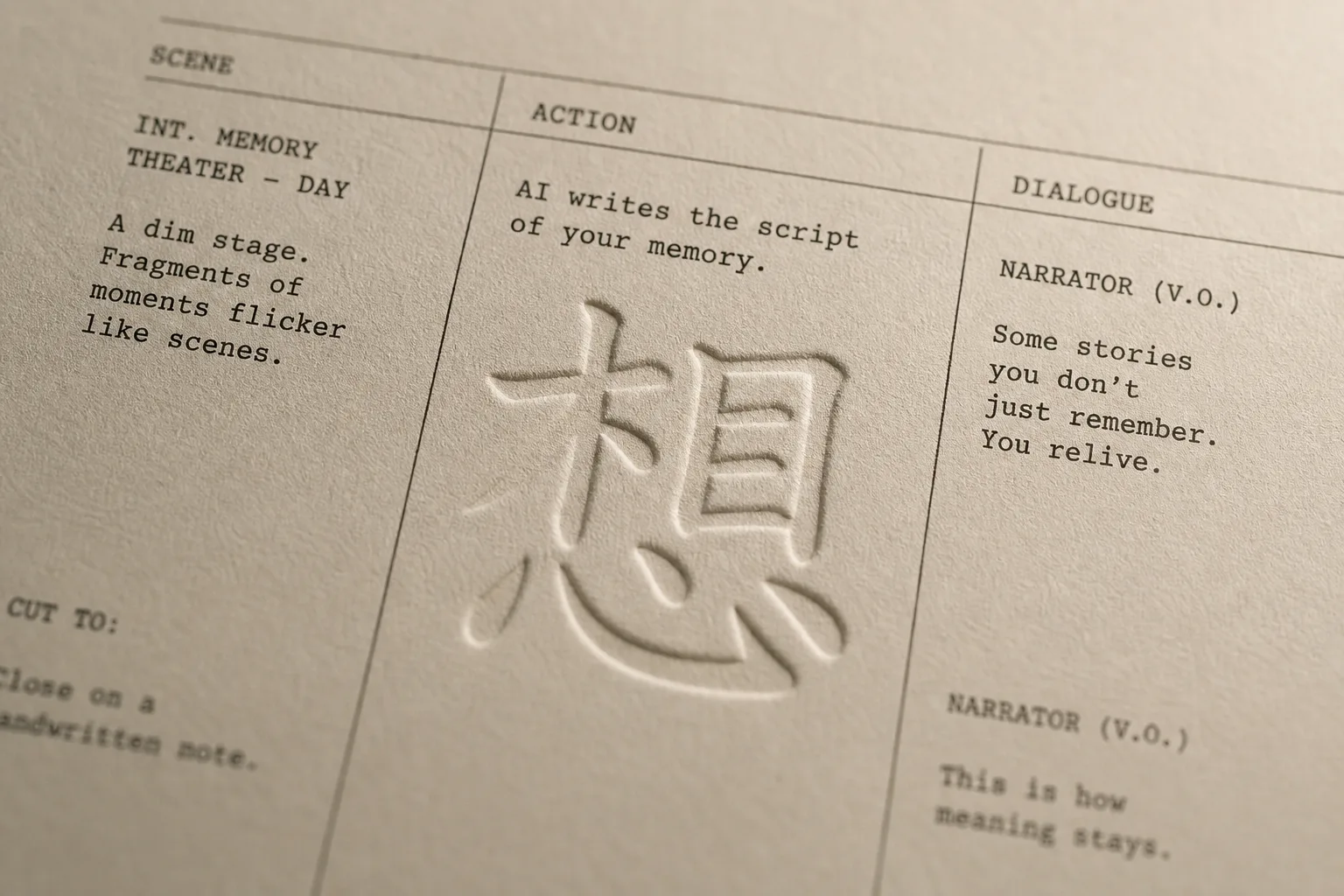
Phil Crimmins and Luke Neale at Mandarin Blueprint systematized and developed the Hanzi Movie Method. It builds on Serge Gorodish's “Marilyn Method” and uses cinematic mnemonics for Chinese characters: each character is broken into five elements (Actor, Set, Room, Props, Script). Writing the scripts by hand is the bottleneck. In my own rough working trial, that took 5 to 10 minutes per character. Extrapolated to a goal of 300 characters, that is 25 to 50 hours. A browser app automates this step and makes script creation easier to scale.
Try it now
Open Hanzi Movie Studio: currently free for users, with no sign-up and no personal API key. Saved learning progress stays in your browser; scripts are available in English and German.
If you test the app, send me a quick note about what you like and where it falls short. The project depends on exactly that kind of feedback.
The Hanzi Movie Method
Phil Crimmins and Luke Neale, the founders of Mandarin Blueprint, systematized and developed the method based on Serge Gorodish's older “Marilyn Method.” The idea is to store every character as a short movie scene in your head.
This is how it works:
- Actors represent the initial sound of the syllable. You choose people you know well, real or fictional.
- Sets are the final sound. Places you can picture vividly: your old apartment, your school, your office.
- Rooms encode the tone. The hallway is tone 1, the bedroom tone 3, the bathroom tone 4.
- Props are the radicals, the visual building blocks of the character.
- The script brings everything together: a short, absurd scene in which the actor interacts with the props and illustrates the character's meaning.
Sounds like a lot of work? It is. You have to invent a unique movie scene for every single character. The app's local HSK 3.1 Band 1 dataset currently contains 265 pronunciation cards for 264 different Hanzi, in other words 265 creative writing exercises. It does not yet fully cover the 300-character target.
One Character, Start to Finish
Take 好 (hǎo, “good”). The syllable breaks down into the initial h-, the final -ao, and the third tone. The character itself consists of the components 女 (woman) and 子 (child).
Suppose Harry Potter represents the initial h- in your toolkit, while Grandma's house represents the final -ao. The third tone takes the scene into the bedroom. Here is how the pieces fit together:
| Element | Encodes | In the scene |
|---|---|---|
| Actor | Initial h- | Harry Potter |
| Set | Final -ao | Grandma's house |
| Room | 3rd tone | Bedroom |
| Props | 女 + 子 | a woman, a baby |
| Script | Meaning “good” | the scene below |
In the bedroom of Grandma's house, Harry Potter floats over the bed in slow motion, a woman in one arm, a baby in the other. Both start to glow: everything is good.
When you want to recall hǎo later, the movie runs backward. Harry gives you the h, Grandma's house the ao, the bedroom the third tone, and the glowing family the meaning. Normally, you would have to invent a scene like this for every character. This is where the app takes over.
The Problem
I used the method manually for a while. I assigned actors, defined sets, and picked props. Everything went into a spreadsheet. Then I sat down to write a script for each character: a short story absurd enough to stick but coherent enough to convey the meaning.
After 30 characters, I knew this would not scale for me. Each character took roughly 5 to 10 minutes. At 300 characters, that would be 25 to 50 hours of scriptwriting alone.
AI Takes Over the Scripts
The method has a formalized structure: actor, set, room, props, and meaning. That makes it suitable as a prompt for a language model.
So I built an app: Hanzi Movie Studio. You maintain your personal toolkit of actors, sets, and props, select a character, and the app generates a matching script server-side through Cloudflare Workers AI. You choose whether the scene is written in English or German.
The result is a movie scene in your language, with your actors, on your set. All you have to do is read and imagine it.
Learn Pimsleur Mandarin and Hanzi in Parallel
Pimsleur mainly trains listening and speaking. That can leave a gap in the written language: if you do not learn the Hanzi in parallel, you may eventually know a word by ear but still have to learn its characters later.
The new Pimsleur filter in the Library closes that gap. Choose “Through lesson 10,” for example, and the app shows only Hanzi that have appeared by that point in the course and are also present in the app's HSK Band 1 library. Each card shows its first Pimsleur lesson with a badge such as P01 or P08. Combine the filter with “Unfilmed” to see which characters are still missing at your current point in the course.
The filter is based on a manually checked mapping for Pimsleur Mandarin Course I, lessons 1–30. Pimsleur lists its current introductory course as Chinese (Mandarin) Level 1 with 30 lessons. Other editions and levels have not yet been mapped. Hanzi Movie Studio is an independent tool; it has no connection to Pimsleur or Simon & Schuster.
Your First Script in 5 Minutes
- Open hanzi.martin-moeller.biz. No account, no API key: the app runs right in your browser.
- Add a few actors and sets to the Toolkit. The combinations for your first character are enough to get started; the rest can grow with you.
- Pick a character from the Library. The app shows its pronunciation, meaning, and components.
- Generate a script in the Studio, in English or German. If you do not like it, generate another or rewrite it yourself.
- Listen to the pronunciation and save the scene. From then on, the character appears in your daily review.
What the App Can Do
Feature list as of August 15, 2026. The interface is in English; scripts and reading exercises can be generated in English or German.
- Manage your toolkit: create and assign actors, sets, and props
- Generate scripts: at the press of a button, based on your toolkit
- Listen to pronunciation: play pre-generated audio clips directly in the app
- Reading exercises: AI-generated short stories using the characters you have learned
- Language selection: scripts and reading exercises in English or German
- Pimsleur filter: select matching Hanzi through your current lesson
- Track progress: SRS-based review
- Export/import: back up your data as JSON or export it to Anki
Tech Stack
- React + TypeScript
- Vite
- Cloudflare Workers AI (Qwen 3 30B) for scripts and reading exercises
- pre-generated neural TTS audio clips for pronunciation
- Cloudflare hosting
- localStorage for all learning data
Your saved learning progress stays in the browser. For AI generation, the app sends the required character, meaning, and toolkit information to a Cloudflare Worker function and Workers AI. The app has no learning database of its own. Cloudflare states that it does not use Customer Content to train models without explicit consent. You do not need your own API key; availability and limits depend on the project's current Cloudflare allocation.
Frequently Asked Questions
What Is the Hanzi Movie Method?
Phil Crimmins and Luke Neale of Mandarin Blueprint systematized and developed the Hanzi Movie Method based on Serge Gorodish's older “Marilyn Method.” It encodes a character's initial, final, tone, components, and meaning as a short movie scene.
Is Hanzi Movie Studio Free?
It is currently free for users, with no subscription and no advertising. Availability and limits depend on the project's Cloudflare allocation.
Do I Need an Account or an API Key?
No. You need neither an account nor your own API key. Saved learning progress stays in your browser's localStorage. For generation, the required character, meaning, and toolkit information goes to the rate-limited Cloudflare Worker function and Workers AI; the app does not operate its own learning database.
Does the App Work in German?
The app's interface is in English. In the Dashboard settings, you can switch scripts and reading exercises between English and German.
Which Pimsleur Mandarin Lessons Does the App Support?
The filter currently uses a manually checked Course I mapping for lessons 1–30. Other Pimsleur levels and editions have not yet been mapped.
How Is the App Different from Mandarin Blueprint?
Mandarin Blueprint teaches the Hanzi Movie Method as a course. Hanzi Movie Studio is a free, independent tool that automates script creation. It has no connection to Mandarin Blueprint and does not replace the course.
Can I Take My Data with Me?
Yes. Your learning data stays in your browser's localStorage, and you can back it up as JSON. You can also export it to Anki for continued use.
Try It
The app runs at hanzi.martin-moeller.biz. Add a few actors and sets, choose a character, and generate a script. The first scenes feel strange. After about 20 characters, you'll notice you can recall them without thinking. That's my own experience, not a guarantee of your pace.
When you get that far, write to me about whether the method works for you, what is missing, and what gets in the way. The app is currently a free Lab project. Honest feedback is the price.
More from the Lab
- Humanizer (German): a Claude skill for more human AI text: 72 German AI-writing patterns, edited with a free open-source skill.
- Voice AI with Gemini Live: a prototype built in 3 hours: another Lab project, for cents per call.
- Profile: who is behind this Lab.